


When we hold a piece of craftsmanship in our hands, we're often captivated first by the beauty of its shape and color. In my own experience covering numerous crafts, I admit I've tended to focus on the ornate designs and the artisan's exceptional skills, seldom pausing to deeply consider the foundational "material" itself.
However, as I delved into the world of Edo Kiriko, one fact truly moved me: a single glass vessel is crafted through a profound dialogue with its material, a process of listening intently to its voice. Perhaps its brilliance isn't just mere decoration, but an inevitable radiance, born from drawing out the absolute potential of the glass.
The Source of Radiance: How Two Types of Glass Expanded the Horizons of Expression
At the core of Edo Kiriko's beauty lie the inherent properties of the glass itself. Historically, the glass used for Edo Kiriko can be broadly divided into two main types: soda-lime glass and crystal glass. When new glass manufacturing techniques were introduced from the West during the Meiji era, Japan began producing its own materials suitable for Kiriko.
Soda-lime glass, being relatively hard and lightweight, is a versatile material widely used for both commercial and everyday Kiriko pieces.
In contrast, crystal glass is softer and has a more substantial weight. It is this very "softness" that has profoundly unleashed the creativity of artisans. As one craftsman noted, "Without the introduction of crystal glass, the deep and exquisitely intricate patterns we see today would never have come to be."
Moreover, crystal glass possesses a remarkably high refractive index. When light hits the cut facets, it reflects and disperses complexly within the glass, sometimes creating a rainbow-like shimmer. By carving complex patterns—such as deep, sharp V-shaped cuts or the "Kikutsunagi" pattern, where fine, continuous engravings resemble a chrysanthemum flower—artisans create the magnificent sparkle unique to Edo Kiriko. This signature brilliance is a direct result of the material's physical properties.
Perhaps glass is not merely a passive recipient of the artisan's work, but an active partner, responding to their skill with its own inherent qualities and radiance.

Image courtesy of the Edo Kiriko Cooperative Association
The Ingenuity of 'Irokise' Glass: Creating Vivid Color Contrast
Integral to Edo Kiriko's visual identity is a special material known as 'Irokise' (cased color) glass. This refers to a two-layered glass created by fusing a thin layer of colored glass—such as lapis lazuli blue (ruriiro) or crimson (aka)—onto a clear glass base. This very material is what gives rise to the art form's signature vibrant color contrast.
Artisans delicately carve away only this colored outer layer. As they do, the clear glass of the underlying layer is revealed, allowing the pattern to emerge in sharp relief. From a material standpoint, this is an aesthetic of subtraction—creating beauty not by adding, but by removing, by 'subtracting' from the surface. The colored layer is incredibly thin; grinding too deeply can pierce and ruin the glass. The process of precisely carving to a uniform depth demands immense concentration and masterful skill.
This high-quality 'Irokise' glass blank (the plain, unprocessed material) is not made by the Kiriko artisans themselves. In most cases, it is crafted by specialized glass manufacturers who supply the materials to Kiriko workshops. Consistently producing glass blanks with a uniform surface and a beautiful cased-color layer is a highly specialized field requiring advanced techniques. Thus, a beautiful piece of Edo Kiriko is the result of a division of labor, supported not only by the Kiriko artisan's skill but also by the craftspeople who create the exceptional materials that make it all possible.
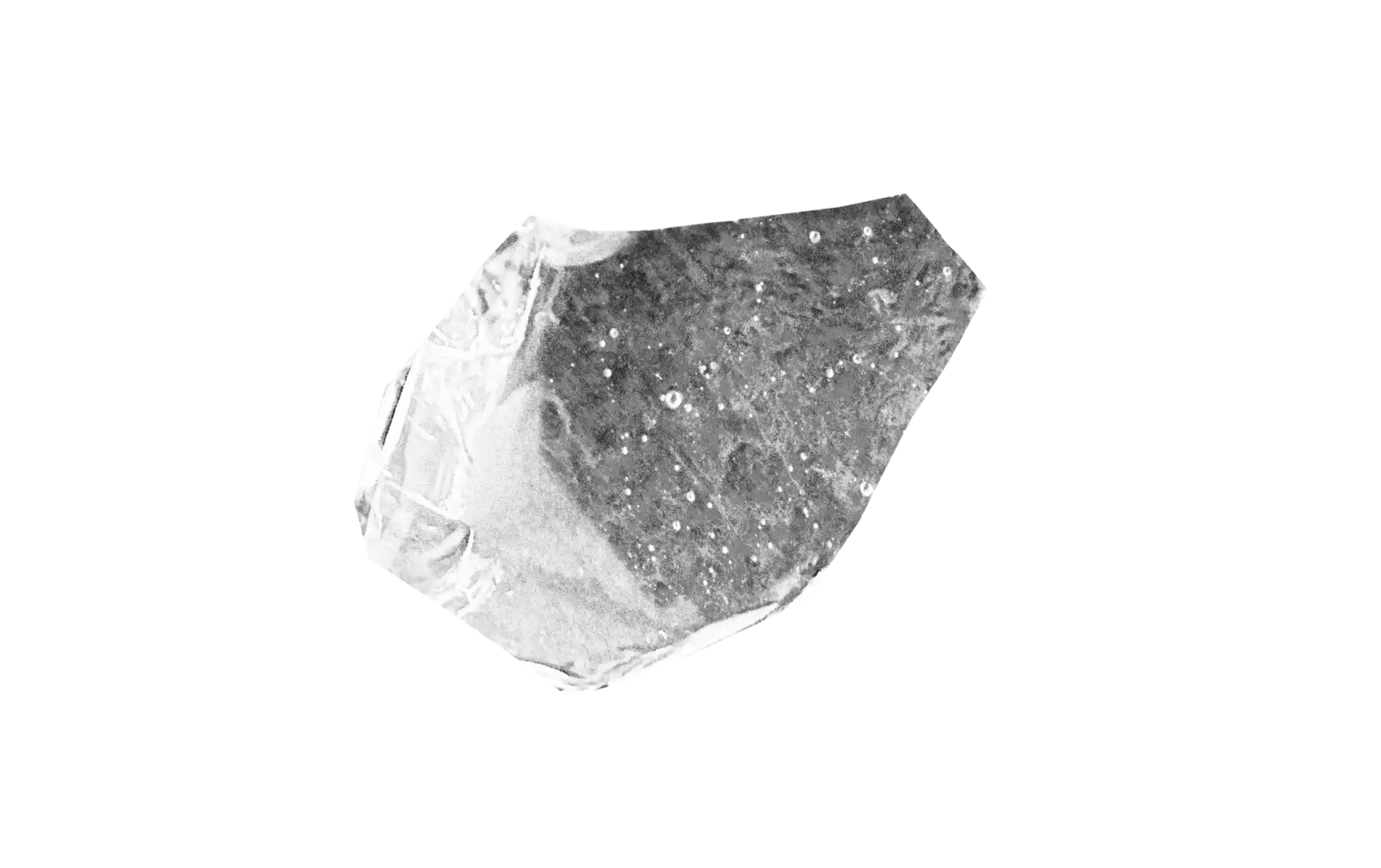

Image courtesy of the Edo Kiriko Cooperative Association
An Artisan's Senses: A Quiet Conversation with Glass
How do artisans truly connect with their material, glass? The process is much more than a matter of hand-eye coordination. In fact, senses other than sight play a crucial, decisive role.
Take, for instance, the cutting process where glass is pressed against a rotating whetstone (grinder). Here, the artisan focuses their entire being on the subtle vibrations traveling through their hands and the shifting sounds of the grinding. As one veteran artisan explains, "I listen to the 'voice' of the glass through the sound of the whetstone and the feeling in my hands, adjusting my pressure and angle accordingly." You could call this a form of 'perceptual intelligence,' a wisdom ingrained in the body through years of dedicated practice. With this heightened awareness, they can sense and correct millimeter-sized imperfections and variations in the glass—imperceptible to the naked eye—to carve flawless geometric patterns.
This intuitive sense is especially vital when working with opaque materials like black Edo Kiriko. Since the clear glass layer beneath the black is invisible, artisans must rely solely on their sense of touch, hearing, and vast experience to gauge the precise location and depth of their cuts. It's a masterful skill, bordering on divine, that would be impossible without a complete, embodied understanding of the material's properties. By comprehending the physical nature of the glass, listening for its 'voice,' and engaging in this dialogue, a single work of art emerges from these moments of quiet intensity.
Sourcing Raw Materials: The Challenge of Passing on the Sparkle to Future Generations
To carry the beautiful brilliance of Edo Kiriko into the future, the challenge of securing a stable supply of materials is just as crucial as passing down the techniques. Specifically, the number of workshops capable of producing high-quality cased glass (iro-kise glass) is limited, and their continued existence is a critical issue for the entire industry.
The world of traditional crafts is a delicate ecosystem. The creation of a single piece relies on a network of specialized artisans. The cutting artisans can only showcase their skills because there are others who make their tools and, crucially, their raw materials. If the workshops producing the base glass were to close down due to issues like a lack of successors, Edo Kiriko artisans, no matter how skilled, would be unable to practice their craft.
This isn't a problem unique to Edo Kiriko; it's a structural challenge facing many traditional crafts. The efforts of a single workshop are not enough. It requires an industry-wide perspective on how to maintain and support the foundation of material production. Behind every single glass we hold, there lies this complex and delicate network of creators.

The next time you choose a piece of handcrafted art, why not look beyond its beauty? Consider the materials that give it its brilliance and the ecosystem of artisans that surrounds it. When you do, that single item is sure to feel all the more precious and irreplaceable.
Edo Kiriko's light is born from a dialogue with a silent partner: glass. It is our deepest hope that this brilliance, fostered by a dedicated network of creators, will continue to be passed down unbroken for generations to come.

