
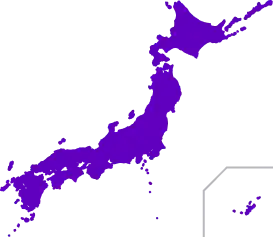
Hiroshima
Yuki Shinohara
Yuki Shinohara, Representative of Shinohara Textile Co., Ltd. She joined Shinohara Textile, learned the full fabric manufacturing process, and became president.
Denim
Denim is a woven textile material that developed in the Sanbi region, centered around Fukuyama City in Hiroshima Prefecture and Okayama Prefecture. It is a thick and durable twill fabric woven from coarse cotton yarns. Typically, the warp yarns are dyed with indigo or other colored dyes, while the weft yarns remain undyed white cotton. Denim is used for a wide range of garments, including jeans, shirts, and dresses.
Most people are likely to own at least one piece of clothing made from denim. If you take a closer look at the denim fabric, you'll find the shine of craftsmanship.
Denim shows various expressions not only by the material, but also by the weaving process. Specializing in the manufacture of such denim fabric is Shinohara Textile Co., Ltd., located in Fukuyama City, Hiroshima Prefecture. The company was founded in 1907, starting from Bingo Kasuri manufacturing, and has been continuously producing textiles for over 115 years until it reached the current denim production.
They particularly excel at creating denim with a sophisticated expression, using materials such as Tencel™ and recycled polyester. We interviewed Yuki Shinohara, the representative of the company, about the deep charm of denim. The more one delves into the depth of denim, the more captivated they will be by its charm, and their love for denim will only deepen.
From Kasuri Textiles to Denim Manufacturing
Shinohara Textile has been around for more than 115 years. First, could you tell us about your journey to becoming the representative of the company?
I was born and raised in this town of Fukuyama. My family home is right next to the denim factory that our company operates, so it was part of my daily life to watch the factory scene from the windows. I spent my time until graduation from high school in Fukuyama, and then went on to a technological university in Osaka. After graduation, I thought, 'If I'm ever to take over the family business, I'd like to learn about the yarn, which is the pre-process of the fabric,' so I got a job at Taishoboseki.
This spinning company was a unique business that not only supplied the yarn necessary for making fabric according to orders from weaving and knitting factories, but also proposed yarns that included fabric and products. Here, we thought about the overall process from cotton to product, and proposed how to make products in various steps to companies.
At Taishoboseki, I got to study in various production areas and sold a variety of yarns. In addition to Okayama and Hiroshima, which are denim producing areas, I also visited towel makers in Imabari, knit makers in Wakayama, sock makers in Nara, and so on. During my 7 years there, I experienced a lot of things, from machine maintenance at the factory to product development and sales.
Then, I joined Shinohara Textile again to learn all the processes of fabric manufacturing and became President in 2022. Currently, my two younger brothers and I are all active in Shinohara Textile.

Do you still make use of the network cultivated at Taishoboseki?
Yes, we do. I still get a lot of learning opportunities from the customers and companies I interacted with back then.
I visited non-denim textile production areas such as Imabari (towels), Wakayama (circular knitting), and Nara (socks), exchanged information, and made things with common materials.
There are various textile production areas in Japan, and each area has its own unique fabrics. We combine these techniques with our denim production area, especially with the indigo rope dyeing technique used in denim, which fades and changes and is unique to this area (Hiroshima, Okayama).
We're advancing the development of non-denim fabrics, experimenting with weaving denim with soft yarns for knitting, and exploring new possibilities day by day.
We have built a relationship where we sell these new fabrics together, buy and sell fabrics, and help each other to create better products.

What changes have occurred at Shinohara Textile since Shinohara became involved in the business?
Our company was originally founded in 1907 and started manufacturing woven fabrics. In the beginning, we worked with kasuri textiles, but as times changed, we switched to manufacturing denim. For a long time, we have woven various fabrics, sometimes planning and selling 100% of our own products, and at other times becoming a subcontractor for major spinning companies.
As the current chairman also acted as a subcontractor, accepting requests from major spinning companies and factories both within and outside of the production area, we have had connections with other companies in the same industry for a long time.
Since we brothers started being involved in the business, our eagerness to work on material development through interaction with other production areas, as well as within the area, has increased. I believe this change in mindset was established around the same time we joined the company.
Did this change come from an aim to boost the denim industry?
That's part of it. In the apparel industry, Okayama is generally known as the production area for denim, but in reality, Fukuyama also plays a significant role.
Until now, there have been few companies in Fukuyama that handle the manufacturing process up to the final product, so it wasn't well-known to the general public. Therefore, we thought we wanted to raise its profile even more.
For example, in terms of production volume, just as potatoes are associated with Hokkaido, denim tends to have a weak connection with specific regions.
While it is sufficient if the denim product itself is excellent, in recent years, transparency, sustainability, and traceability have become important. We thought that if these elements could inform people about where the product was made, they would develop a deeper attachment to the clothing.
Therefore, we believed it was important to disseminate more information and work in collaboration with other companies.

What specific initiatives are you implementing?
About 10 years ago, during the heyday of fast fashion, the demand for denim was in a slump. During that time, it was challenging to acquire customers by simply creating and selling good products. The situation was such that we couldn't compete on price or respond to foreign markets.
To break through this situation, we needed to convey the allure of our products and our dedication to the manufacturing process. For example, we believed that if we explained how our denim was made from sustainable cotton grown in American fields and shared the stories of the people in those cotton fields, the appeal of that material would increase even further. This was a time when we focused on the types of materials.
Until then, our work was just about completing the tasks given to us, and the workload was decreasing. This led us to feel the need to plan and develop our own products, which resulted in a variety of items being produced. As of now, about 75% of our sales come from products planned and developed in-house.
In the denim market, it is often pointed out that the types of denim recognized are extremely limited. For general users, they only see variations in similar designs or different colors.
In reality, denim has a variety of expressions, and the expressions are rich. If there are interesting designs and denim that matches personal tastes, users can enjoy denim even more.
According to recent news, the share of domestically produced denim in Japan is very low, and most of the denim circulated is imported. Therefore, our company is also focusing on selling Japanese denim overseas.

Denim is a Material that Continues to Evolve with Room for Exploration
Could you tell us about the characteristics of the materials Shinohara Textile offers?
We mostly offer denim materials with a neat image within the casual range. We also have fabrics made from environmental-friendly fibers such as Tencel™, which is created from thinned wood, recycled polyester, and recycled cotton.
Tencel™, in particular, has very smooth fibers, and must be handled carefully during weaving to prevent strain on the yarn.
Denim woven from this delicate Tencel™ takes dye well, and presents a supple and refined sheen. This allows for unique products with distinct and evolved features compared to those made from cotton materials.
How many types of denim fabrics are there?
There are approximately 1,000 types. The thickness of the yarn changes the thickness of the fabric. This in turn changes the character and texture of the fabric.
The thickness of the yarn can be made deliberately uniform, or on the contrary, can be altered to create a distinctive texture in the fabric. The thickness of the yarn and the way it is treated can give the fabric its own unique feel and expression.
There are various materials such as cotton, Tencel™, hemp, wool, and polyester, each with its own unique characteristics. By arranging these materials in different combinations and weaving patterns, a variety of expressions are created in the denim fabric.
Thanks to these combinations and arrangements, the feel and texture of denim vary, opening up infinite possibilities. There may even be new discoveries yet to be found. Denim is a material that is always evolving and has room for exploration.

Please also tell us about various collaborations both in Japan and overseas.
In Fukuyama City, where companies specializing in dyeing, weaving, sewing, and washing processes are concentrated, we collaborate with these companies in an initiative to spread denim throughout the city, called 'the Itoguchi of denim'.
Also, jeans using denim manufactured in our factory are sold by fukuyama factory guild', a factory brand under NSG Group.
The tags attached to their jeans clearly indicate who is involved and how.

We also manufacture and sell upcycled products, have our fabrics commissioned for restaurant, lodging, and corporate uniforms, have signed an official denim partnership agreement with Fukuyama City FC and are involved in product development with the team.
We also had our fabric used as a souvenir for the Hiroshima G7 Summit.
We consider these initiatives to be critical in conveying the story behind our manufacturing process, and aim to continue expanding them in the future.

Becoming the Chosen Denim Production Region
You apparently also focus on international initiatives. Please tell us about your future plans.
Overseas, especially in Europe, our company name is hardly known. When people mention Japanese denim in Europe, other company's names come up. We want to be a company that is recognized worldwide in the same way.
To achieve that, we believe we need to go overseas, have discussions with local people, show them our materials, and develop products based on their feedback.
Since around 2019, we have actually been participating in exhibitions in Milan, exchanging information with local brand designers.
There, we gain various insights. For instance, we once found that our recycled polyester material was not well-received.
On the other hand, we received high praises for the feel of our Tencel™, a refined cellulose fiber, allowing us to understand local preferences for materials directly. Hence, actually going to these places and learning about overseas reactions will be our challenge in the future.
We aspire to be a company that continues to produce materials of true worth, highly valued all over the world.
Direct conversations and inspections of the fabric are extremely important, aren't they? I heard that in Japan, you also carry out such activities aimed at students.
We are engaged in various activities mainly to communicate the appeal of denim to local children. From school field trips for elementary students, internships for high school students, to lectures at universities, we hope these experiences will imprint the memory of denim in them as they grow up.
For instance, I remember a factory visit to a bakery when I was in elementary school where we received delicious bread to eat. That experience has stuck with me, and I still feel a natural desire to visit that bakery.
That's why we actively provide children with opportunities to encounter denim. We want them to take an interest in their everyday clothes from a different perspective.
Our goal is, first of all, to educate people about denim. We hope to become a presence that people remember when they become adults and start choosing their own clothes, thinking, "Ah, I visited a factory in Fukuyama."
From such experiences, we think it would be most gratifying if there were people who would ask, "Where is this fabric produced?" when they see denim. And we aim to become the place of denim production that is chosen at that time.
.JPG?w=430&fm=webp&dpr=2)
Lastly, could you share with us the future prospects of Shinohara Textile?
Manufacturing in Japan involves costs such as labor to maintain the standard of living in developed countries, and energy, and there are also transportation costs when exporting products overseas. We cannot win in price competition with Asian countries.
Therefore, we are focusing on ideas and designs. For example, we are trying to differentiate ourselves with the interesting appearance of denim, such as its exquisite color and texture. There are not many domestic denim manufacturers that produce similar products. This is because each company has its own unique features and differentiation is advancing in each.
For this reason, while collaborating using the material, we aim to increase recognition as a denim manufacturer in Fukuyama. We want to continue initiatives that will make us a chosen company by cooperating with various companies and PR in overseas as well, and attracting attention to Japanese denim fabrics.


Japanese Craft Glossary
The History of Arimatsu Shibori: Tracing 400 Years of Turning Points From 1608 Settlement to Global Fashion

Seeking the Artisans
