
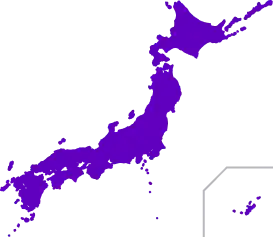
Gunma
Keisuke Sano
Keisuke Sano Lacquer artist. He creates works using lacquer techniques such as raden, maki-e, hyomon, and kanshitsu.
Urushi lacquer art
Urushi lacquer art has been passed down across Japan for centuries. Using techniques such as raden, maki-e, hyomon, and kanshitsu, which were introduced from China during the Nara period and later developed uniquely in Japan, artisans combine lacquer, shells, and metals to create their works. The craft encompasses a wide range of forms and functions, including vessels, small boxes, accessories, and sculptures, and continues to evolve into contemporary artistic expressions.
Is this a tool, a work of art, or perhaps a new form of prayer for the future?
When you see Keisuke Sano's series of small boxes, called "Enigma," anyone will feel their notions of "traditional crafts" being shaken. Each surface of these 5.3 cm cubes is densely decorated with techniques such as Raden (mother-of-pearl inlay), Hyomon, and Maki-e. While using Urushi techniques that have existed for hundreds of years, the expression is completely new. We visited the studio of this 31-year-old young artisan, who creates these mysterious works.
Encounter with Crafting: The Crossroads of Urushi & Rocket Engines
Sano was born and raised in Takasaki City, Gunma Prefecture, and still bases his creative work there. The reason he set out on the path of traditional craft was quite a simple encounter.
"Ever since I was a child, I loved making things with my hands. I remember being shocked the first time I encountered a piece of traditional craft—the light would change color between red, green, and blue as I looked at it from different angles. I wondered, what is this beautiful thing?"
That was "Raden." By cutting a seashell paper-thin, sticking it onto wood coated in Urushi (lacquer), and then recoating it with Urushi and polishing the surface, the shimmer of the shell emerges. This Urushi technique came from China to Japan during the Nara period and evolved uniquely. Without even knowing the technique, he was deeply drawn to it. But, surprisingly, Sano originally aimed not to be a craft artist, but a mechanical engineer.

"I couldn't imagine making a living through traditional crafts. If I was going to go into manufacturing, I wanted to try making the most complex machines possible. In high school, I was thinking of working for a rocket engine manufacturer."
However, one day an art teacher introduced him to the craft department at Tokyo University of the Arts. Learning that there was a way to make traditional crafts a profession, he changed course and enrolled there.
He continued on to graduate school, focusing on the preservation and restoration of cultural properties, and planned to take a job at a museum or foundation as a specialist.
If you’ve read this far, you might notice it: despite his avant-garde style, Sano is a surprisingly down-to-earth and gentle young man.

"Preservation and restoration is fascinating in how it lets you untangle and relive the techniques of people from the past. But while working on production classes in undergrad, I started to really want to create things myself. As I interacted with Urushi, new ways I could use the material kept coming to mind."
Starting from conservation and restoration, Sano pursued “materials research” with single-minded focus. After mastering the basic skills at university, he launched into solo artisan work, personally handling every step from base-making to decoration and lacquering.
This slightly unusual background comes through in his body of work.

Pioneering Techniques: Unstoppable Expansion of Urushi Expression
Sano’s studio is a room in a mixed-use building about ten minutes’ walk from Takasaki Station. On a simple work desk are brushes and other tools, alongside materials like Urushi wood and seashells.
All around are small boxes that fit in your palm, practical items like sake cups, accessories like rings and earrings, and even standing statues nearly 100 cm tall.

"This sculpture was created using 'dry lacquer.' It’s a technique in which Urushi lacquer is soaked into hemp cloth and hardened to form shapes—a method often used for Buddhist statues until the Nara period. Rather than just decorating vessels, I wanted to create entire spaces."
That such colorful and vivid textures are possible with familiar Urushi is surprising. As an individual craftsperson, he can’t mass-produce like a big studio, but the range of expression is astonishing. When asked how he comes up with new techniques, an unexpected answer came back.

"What I use are all lacquering techniques that have existed for over a thousand years already. But there are still endless possibilities for new forms of expression. By combining the protective sap of the lacquer tree with seashells and metals, you can touch upon the mysteries of life. It's hard to put into words, but what I want to express is a kind of 'law.' It might be something like the crystal structure of minerals, circuits, or perhaps something like 'fluctuation.' I also resonate with cosmology and molecular biology."
On the work desk where Sano continues to pursue this 'law," there was a black small box before any decorative work had started. It was impossible to imagine what kind of lacquer expression would be born on top of it. How much do we actually know about "lacquer"? What is generally labeled as "traditional crafts" could actually be expression in a very limited sense.

The Future of Craft: The Incomplete "Tradition"
Sano’s studio is also equipped with modern tools and a 3D printer, offering efficiency in the crafting process. Is there, perhaps, a certain distance taken from strictly traditional practices?
“For precisely cutting shell pieces, I use tools I made myself. And for the molds of earring and piercing bases, I utilized a 3D printer. While I streamline these operational aspects, I have no intention of straying from the traditional forms of materials and techniques developed since ancient times. I make sure to finish every piece by hand.”
Despite being young, Sano pursues his craft career entirely on his own. What does he hope for in the future of crafts? After prefacing, "I’m not really one to speak out in society," he continues:
“The foundation of so-called 'traditional crafts' was established about a hundred years ago, around the time from the Meiji to early Showa periods when domestic travel became popular and lacquer bowls lined the tables of inns. As Japan’s economy grew, crafts became divided into specialized roles and mass production kicked in, turning it into an ‘industry’ almost overnight. But as the market shrank, these crafts became objects of protection under the label of ‘tradition.’ But is it enough for crafts to simply be protected relics of the past? For instance, Japanese people have used chopsticks since the Heian period, but no one calls that ‘tradition’—it’s just assumed people will use them tomorrow, next year, and even a hundred years from now. Culture, by nature, is supposed to continue this way, isn’t it?”

Of course, there is value in the "beauty of utility" found in mass-produced objects. But if we cannot return to the era of mass consumption, where should we go from here? Sano goes on:
“I love the phrase ‘Onko chishin’ (温故知新, which means 'learning from the past to discover new things'), and I think the answer for crafts moving forward may be found by looking at how things were before industrialization. That’s why I insist on carrying out the entire process myself.
After all, lacquer has a history of well over a thousand years, with great freedom and unfinished possibilities in technique. Makers should pursue materials and ingenuity, aiming to express breathtaking beauty that needs no explanation. That’s how history has always been updated.
Just as there is ‘art’ in the West, there is ‘craft’ in Japan. As a craftsperson in Japan, I want to take pride in that.”
When I was once captivated by the mysterious glow of Raden, it surely wasn’t because it was a technique dating back to the Nara period. Even now, Sano likely holds onto that feeling, the awe of encountering beauty created purely by human hands. While creations by a new generation of artisans may differ from so-called traditional crafts, they undoubtedly carry on the spirit of craftsmanship.

Text by GANTAN

Japanese Craft Glossary
The History of Arimatsu Shibori: Tracing 400 Years of Turning Points From 1608 Settlement to Global Fashion

Seeking the Artisans
.jpg?w=430&fm=webp&dpr=2)
.JPG?w=430&fm=webp&dpr=2)